Vibration Damping and Deadening Material Solutions
Home / Applications / Vibration Damping, Isolation, and Sound Deadening
Marian manufactures die-cut components using highly engineered materials that are formulated for sound deadening, vibration damping, vibration isolation, and noise reduction. Many machines and devices produce unwanted noise and vibration as they operate, which can cause damage to sensitive components, leading to product failure as well as the production of annoying noise. With Marian’s custom solutions using specialized sound deadening and vibration damping materials, your applications can withstand damage and product failure due to excessive vibration.
Our die-cut solutions for sound deadening and vibration damping materials includes:
- Gaskets
- Pads
- Cushions
- Foil Tapes

The Marian Advantage: Expert Vibration Damping Material Solutions
Wide Range of High-Performance Materials
Precision Die-Cutting and Converting
Vibration Damping and Sound Deadening Material Solutions

Rogers PORON® Urethanes
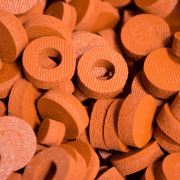
PORON® Urethane foams are an excellent choice for vibration isolation, damping, and noise reduction. They are highly resilient elastomers with excellent resistance to compression set (material collapse) and exhibit good vibration damping characteristics. PORON® urethane elastomers can reflect vibrations over long periods of time, offering stability in a wide range of environments.

Rogers BISCO® Silicones
BISCO® Silicone foams and solid silicone products are a proven, long-term solution to reducing vibration-induced noise and are designed to meet stringent standards for extreme temperatures and flames. BISCO® Silicones meet many important aircraft, rail, and automotive specifications.
3M Vibration Damping Foil Tapes
3M Damping Foil Tapes are self-adhesive, made with viscoelastic damping polymers coated on a dead soft aluminum foil. They are designed for applications where there is a need to control resonant vibrations. Download data sheet.

Sound Deadening Pads
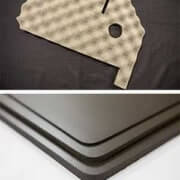
Self-adhesive elastomer pads that suppress noise and vibrations. Pads can be cut to size and applied to structures to deaden sound and vibrations, such as vehicle floors, doors, and body panels, as well as appliance and HVAC systems. Download data sheet.
Markets and Applications
Products in the markets below are designed with added components to control noise and vibration. Marian can help with sound deadening and vibration damping material selection, component design and engineering, and manufacturing of these components to keep your products operating quietly for long-term use.
Automotive + Transportation - NHV / BSR Reduction
Automotive + Transportation – NHV/BSR Reduction
Automobile designs require an extremely quiet experience for passengers. Buzz, squeak, rattle (BSR) also known as noise, vibration, harshness (NVH) are issues that can plague automobile designs and must be addressed to ensure consumer confidence.
Automotive - EV Battery
Aircraft and Aerospace
Portable Electronics
Industrial Equipment
Appliance
HVAC
Medical Device and Equipment
Success Story: PORON Gasket Used in Outdoor Camera System

When a company’s outdoor camera gasket failed to withstand prolonged exposure to extremes of temperature and moisture, and constant vibration from the wind, they turned to Marian for a superior alternative. Read more…
Key Benefits of Vibration Damping and Sound Deadening Material
Enhanced Product Reliability and Longevity
Improved User Experience and Comfort
Protection of Sensitive Internal Components
Our Process: From Analysis to Application
Initial Consultation and Material Selection
Prototyping and Performance Testing
High-Volume Manufacturing with Quality Control
FAQs About Vibration Damping
What is the difference between vibration damping and isolation?
Vibration damping and vibration isolation are two different but effective types of vibration control.
Vibration damping absorbs and dissipates vibrations, converting kinetic energy into heat within the material.
Vibration isolation physically separates objects from vibration sources, preventing energy transfer altogether.
The most effective solutions often combine both methods for comprehensive control.
Want to dive deeper? Check out our blog post on vibration control.
What is the difference between damping, dampening, and deadening?
Damping, dampening, and deadening are often used interchangeably, but they have very different meanings.
Damping is the correct term in the context of vibration, referring to the absorption and dissipation of vibrational energy.
Dampening technically describes dampness or wetness, meaning it is incorrectly used in the context of vibration.
Deadening is used in the context of sound, referring to the blocking or absorption of sound.
What kind of vibration damping material solutions do you offer?
Common vibration damping solutions include gaskets, pads, cushions, and foil tapes. Marian partners with leading material suppliers to deliver these solutions, including materials like:
- Rogers PORON® Urethane
- Rogers BISCO® Silicone
- 3M Vibration Damping Foil Tape
With unmatched converting capacity, we serve a variety of markets including automotive, energy storage, aerospace, HVAC, and medical applications.
How do your solutions improve product longevity?
Vibration damping extends application life by absorbing vibration energy and reducing stress on components. Gaskets, cushions, and pads create a protective buffer between sensitive parts, preventing damage from repeated contact and impact that would otherwise lead to premature wear or failure.
Can you help with material selection for my specific application?
Of course! Our sales engineers bring deep technical expertise and close partnerships with material suppliers to recommend the best solutions for your application.
Do you provide die-cut parts with adhesive backing?
We do! In addition to gaskets, pads, and cushions, Marian is a leading converter of 3M and tesa tapes and adhesives. We can integrate adhesive backing, protective liners, and pull tabs into your custom-cut vibration damping solutions for simplified handling and installation. Check out our bonding, joining, and assembly page to learn more.
How does the prototyping process work?
Marian frequently uses CAD cutting technology to produce prototype parts quickly and efficiently, without the cost or lead time associated with hard tooling. By leveraging lasers, blade cutting plotters, and waterjet cutting, design adjustments can be made faster and more cost-effectively during the prototyping phase.