Optically Clear Adhesives (OCA)
What are Optically Clear Adhesives?
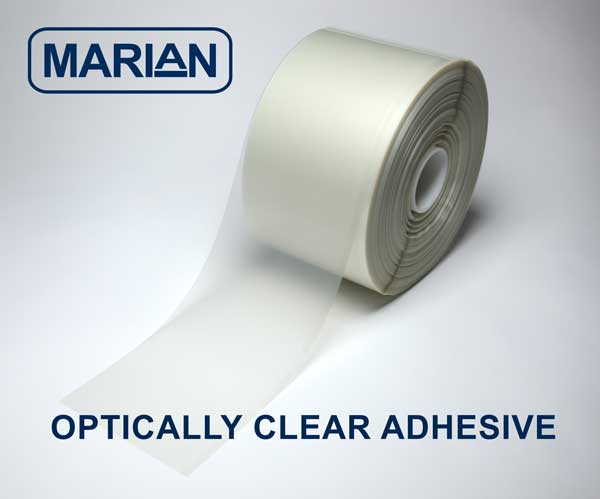
Optically clear adhesives (OCA) are highly specialized adhesive materials that are optically clear, offering superior clarity and excellent adhesion to various types of transparent substrates like film and glass. OCA bonding allows for thinner bond lines. Rigid-to-rigid or rigid-to-flexible bonding with OCA prevents bubbles and air gaps from forming, maximizing optical clarity.
OCAs are used for optically clear bonding in electronic displays, avionics/military displays, touch panels, LCD, and OLED displays.
Material Features of Optically Clear Adhesives
- Extremely high light transmission (>99%)
- High adhesion levels – peel strength and shear strength
- Contaminant free
- Bubble resistant even in high temperatures and high humidity
- Thin bond lines
- Long-term durability without yellowing, delaminating, or degradation
Converting Optically Clear Adhesives
Converting OCAs requires highly specialized processes. The material must remain in pristine condition throughout transport, unpackaging, handling, processing, and repackaging. Marian converts OCAs in tightly controlled and certified clean room environments to provide visually flawless bonds. We have the quality systems, processes, trained staff, and facilities to properly handle, convert, and package OCA materials.
- Clean room/clean environment
- Packaging for clean transport: double-bagged on a plastic core
Marian Converting Capabilities
- Multi-layer lamination, custom thickness range
- Tight tolerance slitting
- Die cutting/kiss cutting to a liner
- Unique process to create top and bottom tabs
- Packaging for automated placement
Commonly Converted Optically Clear Adhesive Materials
3M Optically Clear Adhesive Films 8211, 8212, 8213, 8214, 8215
Construction: acrylic adhesive (1.0 mil – 5.0 mil available), no carrier, release liners are 2.0 mil polyester
3M Optically Clear Adhesive 8171 and 8172
Construction: acrylic adhesive (1.0 mil & 2.0 mil available), no carrier, release liners are 2.0 mil polyester
tesa® 69808 UV-Curable Optically Clear Display Tape
UV-curable optically clear display tape. 7 mil pure acrylic adhesive, on 2 PET liners.
FAQs About Optically Clear Adhesives
How does Marian prevent bubbles in the finished product?
Marian prevents bubbles by tightly controlling material handling, converting processes, and application methods throughout production.
Optically clear adhesives are processed in clean environments using precision lamination and die-cutting techniques that minimize air entrapment. Careful tension control, material selection, and handling procedures help ensure uniform adhesion and a clear, defect-free finished part.
What makes your adhesives suitable for touch panels?
Marian’s optically clear adhesives are suitable for touch panels because they are converted from display-grade adhesive systems engineered for optical transparency, uniform thickness, and stable performance over time. These materials are designed to bond display layers without introducing visual distortion, helping preserve brightness, contrast, and accurate touch response.
By converting optically clear adhesives and films from established suppliers such as 3M, tesa, and Brightview Technologies, Marian ensures compatibility with capacitive touch systems, tight thickness control, and resistance to environmental stresses such as heat, humidity, and thermal cycling.
Our precision converting processes support complex geometries and tight tolerances required in modern touch panel and display assemblies.
How do you ensure long-term durability?
Marian ensures long-term durability through careful material selection and controlled converting processes using optically clear adhesive systems designed for stable performance over time. These materials are engineered to maintain adhesion and optical clarity when exposed to real-world conditions such as temperature cycling, humidity, UV exposure, and mechanical loading.
By applying precise converting techniques that preserve material integrity and thickness uniformity, Marian helps ensure consistent bonding performance throughout the product lifecycle. This approach supports reliable adhesion, sustained optical quality, and predictable performance in demanding touch panel and display applications.
What is the typical lead time for samples or prototypes?
Typical lead times for samples or prototypes using in-stock materials are often 24 to 48 hours.
Actual lead times may vary based on material selection and availability, converting process, part complexity, and any tooling requirements. Marian is structured to support rapid prototyping, allowing design engineers to quickly evaluate fit, function, and optical performance. Early collaboration helps streamline development and supports a smooth transition from prototype to production.
What sets your converting process apart?
Marian’s converting process is distinguished by precision, scalability, and process control, including certified cleanroom manufacturing for optically sensitive adhesive applications.
Our in-house capabilities support tight dimensional tolerances, clean edges, and contamination control, which are critical for optically clear adhesive components.
Marian is also known for solving complex and difficult-to-convert applications, using converting expertise and process development to meet demanding design requirements across both prototype and high-volume production.
Contact us to speak to one of our experts and to learn more about OCAs.