Rapid Prototyping Services for High-Quality, Fast Results

Home / Capabilities / Prototyping

At Marian, we pride ourselves on our ability to produce high-quality prototypes quickly. Prototyping is usually used by the customer to verify design, evaluate material choices, and build small batch prototypes of the final assembly. Provide us with a CAD file (.dxf format is best) along with information about your part, and we can typically prototype your solution within 24 to 48 hours using our in-house stock materials.

Laser prototyping

Reliable Prototype Services To Accelerate Development

Marian’s rapid prototyping services are built to support early-stage product development where speed, accuracy, and manufacturability matter. These prototyping services allow customers to verify geometry, evaluate material behavior, and confirm assembly fit before committing to tooling or full-scale production.

Each rapid prototyping service is closely aligned with Marian’s broader manufacturing process. This ensures that prototype learnings translate directly into production-ready solutions without unnecessary redesign cycles.

Fast Turnaround in 24–48 Hours

Development timelines often depend on quick iteration. Marian’s rapid prototype services are structured to deliver multiple prototypes in short timeframes, typically within 24-48 hours when materials are available. CAD-driven workflows and in-house capabilities enable efficient on-demand production while maintaining consistent quality control and repeatability.

This rapid turnaround allows engineering teams to test design changes quickly, reduce development delays, and maintain momentum across internal review cycles and supplier coordination milestones.

High-Precision, Production-Ready Prototypes

Prototype parts are produced with attention to tight tolerances, allowing accurate evaluation of fit, alignment, and interaction with adjacent components. These functional prototypes are created using proven rapid prototyping processes such as laser cutting, waterjet cutting, plotters, soft tooling, and, when required, rapid CNC machined parts for select designs. 

Marian does not rely on any additive manufacturing process or selective laser sintering for these components, enabling prototypes to reflect final material selections and real-world material properties. This approach supports meaningful functional validation before mass production and avoids discrepancies between prototype and production intent.

Support for Small-Batch Builds and Testing

Marian supports small-batch prototype builds for testing and evaluation. These prototype services enable functional testing, assembly trials, and process checks without the cost or lead time of hard tooling.

As programs advance, options such as rapid tooling and bridge tooling help transition designs toward production-grade materials. This staged approach reduces risk, controls cost, and supports smoother progression into full scale production while preserving design flexibility.

Advanced Prototyping Methods We Use

Prototype parts are typically produced from processes that are not expected to be used when production quantities are required. Read more about the methods we use to produce rapid prototypes below.

CAD Files to Produce Prototypes with Laser, Water-jet, and Plotters

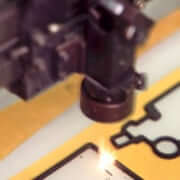
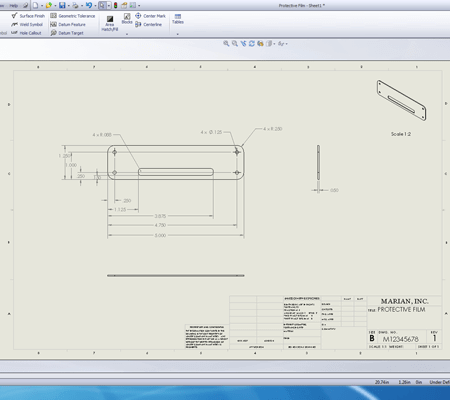
With a two dimensional CAD file (.dxf format preferred), we can import the file to a computer program and are able to cut parts the same day with Lasers, Water-Jet, or Plotters. Each of these methods avoid tooling costs and are able to move very quickly. If materials are stocked or readily available at Marian, we can ship a few prototypes the next day.

The factors below determine whether we use Laser, Water-jet, or Plotter to produce the prototype parts:

  • material composition and the material thickness
  • the foot-print (size) and geometry (complexity) of the part
  • the tolerances required
CAD file used for prototyping

Using “Soft Tooling” to Produce Parts with Flat-bed or Rotary Die Cutting

In addition to the methods mentioned above, we can also build chem-etched or steel-rule cutting dies to produce prototypes on flat-bed punch presses or rotary die cutting presses. While there is some initial tooling expense, “Soft tooling” is typically less expensive than “hard tooling”.

These methods can often achieve tighter tolerance than CAD-cutting techniques. Additionally, the actual cutting process of each part is faster than the CAD-cutting methods described above.

Why Choose Marian for Rapid Prototype Services?

Below are the key reasons to choose Marian for rapid prototype services:

Graduation-cap Graduation-cap

Proven Expertise in Precision Converting

Marian’s rapid prototype service is supported by decades of experience in precision converting across automotive, medical, electronics, and industrial applications. Our teams understand how early design decisions affect downstream manufacturability, tooling complexity, and production efficiency. This insight helps customers avoid redesigns and align prototype outcomes with long-term manufacturing goals and operational constraints.

Check Check

Cost-Effective Rapid Prototype Solutions

Marian delivers cost-effective prototype solutions by minimizing unnecessary tooling and focusing on efficient, scalable processes. Prototype services are designed to shorten development cycles, reduce material waste, and support informed decisions before investing in production equipment or establishing permanent production lines. This approach balances speed with practical manufacturing and budget considerations.

Tools Tools

Flexible Material Options for Every Application

Material versatility is central to Marian’s prototyping approach. Prototypes can be produced from foams, films, adhesives, and other flexible materials, as well as components interfacing with sheet metal fabrication, where required. This flexibility allows accurate evaluation of material behavior early in development, using substrates consistent with production intent and expected operating environments.

Industries We Serve with Rapid Prototyping

Below are the major industries we serve with rapid prototyping:

Automotive & EV Battery Components
Medical Devices & Electronics
Consumer Electronics & Industrial Applications

Automotive & EV Battery Components

Rapid prototyping supports automotive and EV battery programs by enabling early evaluation of sealing, insulation, and thermal interface components. Prototypes help confirm fit, assembly methods, durability expectations, and integration within constrained packaging environments before scaling to volume.

Medical Devices & Electronics

For medical devices and electronics, prototype services support design refinement and material evaluation while maintaining clear boundaries around regulatory and clinical responsibilities. Prototypes are used for functional testing, handling evaluation, and integration assessment only.

Consumer Electronics & Industrial Applications

In consumer electronics and industrial applications, rapid prototyping services help assess complex geometries, assembly methods, and material performance. These prototypes support efficient iteration, supplier alignment, and design convergence before transitioning to mass production environments.

FAQs on Rapid Prototyping Services

At Marian, speed, predictability, and reliability drive everything we do. Lead times for prototypes depend on material selection and manufacturing requirements. To minimize delays, we maintain millions of dollars of raw material inventory. If we have a CAD file and materials are in stock, we are often able to produce and ship a prototype within two business days. Every project has unique timing needs, so contact us to discuss your specific requirements and deadlines.

For small production runs, Marian uses CAD cutting technology to produce parts quickly without the cost and lead time of hard tooling. Our laser, blade-cutting-plotter, and waterjet cutting capabilities make small batches fast and economical, while giving you flexibility to refine your design before scaling up.

All industries can benefit from rapid prototyping. Whether you need a prototype solution for the medical, automotive, electronics, battery, appliance, aerospace, or LED industry, a rapid prototype from Marian is a fast and easy way to test how a material will work in your design.

By using customer-provided CAD files, we can ensure your prototype is manufactured exactly as intended. Marian leverages our premier supplier partnerships to use the highest quality material for prototypes and final designs.

Blog Posts

In Need of Rapid Prototyping?

Contact us for help. You can complete the form by clicking the link below and submit a sketch, drawing, or CAD file. One of our sales engineers will get in touch with you the same or next day about producing your rapid prototypes.

Download our FREE technical eBooks!
Link to: Technical eBooks Link to: Technical eBooks
4 Questions to Ask When Selecting a Pressure Sensitive Adhesive
How to Select the Right Thermal Interface Material
What to Consider When Selecting Foam Material for Static Gaskets & Seals
Considerations with Tolerances When Die Cutting Soft Flexible Materials
Pros and Cons of Designing with Silicone Rubber
What to Know When Selecting Pressure Sensitive Adhesives for Wearable Medical Devices
Marian Certifications